
Posts Tagged ‘steelhead’

2nd Installment: Steelhead Inspired Wine

Monday, August 23rd, 2010

There seems to be a theme here, many fly anglers have their hands in the wine making business as we will continue to show over the coming months.

This month, Lange Estate Winery and Vineyards located in the infamous Dundee region of Oregon gets the nod. Don Lange, owner and winemaker, swung for steel with my dad on the Deschutes awhile back and happens to also produce one of my favorite wines with bottles adorned with tradtional Atlantic Salmon flies.

Next time at the grocery store, swing by and pick up the Pinot Noir or the Pinot Gris Reserve and look a bit more closely at who you are following down through Wagenblast as it may just be Don!

Written by: Dave McCoy

Urban Fly-Fish Guiding

Tuesday, August 10th, 2010

My wife works for a big financial firm and when we go to holiday events with her co-workers, I dress up and look every bit a part of their regular social and work environments. Nearly anyway, minus the sandals, cracked and smelly feet, dirt under my finger and toe nails and gash on my face from latest spey cast gone askew with 2/0 hook.

As we begin to have a few drinks and gather around to chat, the obvious and inevitable question comes up, “What do you do for work?” The reaction to what comes from my mouth ranges about as far as you can imagine.

“That is AWESOME!”

“What is fly fishing?”

“No, I mean now, not what you did in Colorado.”

“Can you do that here?!!” “Can you stay busy and make any money?”

“What would you guide for here, there aren’t any trout streams are there?”

“Do you have a card?”

“Have you seen ‘A River Runs Around It?” No, I haven’t!

“So is that just on the weekends?”

“I thought they only fly fished in Montana?!!!”

“You must eat a lot of fish!”

“How do you keep the insects on the line when casting?”

“I fly fished once, in Montana, 20 years ago….” or “I have fly fished for 20 years, a day a year anyway.”

“Where do you take people? ‘We go everywhere, Puget Sound is one of our favorites.’ You can fly fish in saltwater!!?? What lives out there?”

I think you get the point, not a job those in the 7th largest city in the U.S. can really even concieve of having. And to be totally honest, sometimes I wonder why or how in the hell I came to do this. There is so little that is similar about this to what I did in Colorado and other Rocky Mountain states with one exception, every direction you look there is water beckoning to be fished, maybe more so here and there in lies the start of the problem. There, in the Rockies, it was EASY in nearly every way. Here it is a bitch in nearly every way, allow me to point out how.

1. Guiding in the Rockies meant having to bascially only know trout, that is it. Maybe a few different rivers, launch points and a little navigation and real rowing in a few select locations.

2. Longest drive I ever had was about 40 minutes from the shop to the river for a day trip.

2a. No traffic, not the stand still on 4 lane freeways we have here anyway.

3. Meet at a luxurious 7-8 am usually at the shop.

4. Back from a full day by about 6pm at the latest.

5. In the bar drinking again by 7 at the latest.

5a. Could leave car at fly shop over night and just walk down in the morning to meet next day’s clients.

6. If drove after drinking, knew town marshall by first name and typically had a few drinks with him the night before in the same bar.

7. Went to bed each night KNOWING we were catching fish the next day.

7a. Most likely big fish too!

8. Sleep well knowing the above!

Here in Seattle anyway, we need to know a bit more. There are way too many great fly angling opps in our area to pass up by simply guiding one river. Besides that, when your home river is blown out (or closed!!), which happens here frequently, how do you pay the mortgage? So here are a few of the things we as guides in this urban world need to be great at in order to be successful:

Pre 1. Washington did not win the big resident trout mega lottery, we have a ton of small fish, it is why Sage makes the 000wt.

1. Which way traffic is worst and at what times and how that coincides with where we want to take clients.

2. Must be proficient in all facets of local saltwater, spey casting and anadromous fish, mostly steelhead, resident trout in more than a handful of streams and creeks, tailwaters, freestone and spring creeks. All entomology associated with each, deep familiarization with all equipment coming out that is applicable to each.

2a. Did we mention Pike, Muskee, Bass and Carp? All are here and just waiting to be guided on a fly rod.

3. In the steelhead world, know all launch points on a dozen rivers, which ones fish at what time of year and at what flow.

4. Saltwater, must know at least 30 different beaches to begin to be successful all year in all weather conditions. Knowing which beaches are out of wind, which ones are blown out due to nearby creek flowing in and each of these 30, at least, at every tide level from -4 to +11.

5. In the trout world around here you can live like many by the whims of the Yakima River, one of our only trout managed rivers in the state and certianly the most well known. The Yak still has a dozen float options on it to know well. Wild rainbows here are very fickle so you better know your bugs or it will be a slow one!

5a. Guiding creeks, know at least 20 different ones within 2 hours of Seattle. All access points, options for when someone is there when you arrive.

5b. The what to do when someone is there I have to laugh at because while in destination fisheries, you have more people focused on fishing while there but it will never compare to having nearly 3 million, or more, within 2 hours and 1-2 percent of them focused on fishing. Most of them NOT fly anglers either so not only do you have nothing in common with them, they hate you much of the time. 1 for guiding but secondly for fly fishing. When was the last time you had a person walk over to you with a rock in their hand and say, “You need to get the hell out of here, this isn’t a fly fishing river, go somewhere else, NOW!”

6. The nitty gritty. The 3 things you NEVER talk about with clients — Religion, Money and Politics. Well, here you better be capable of it because most are going to bring it up at some point in the 4 hours you spend in the car with them that day. Yes, 4 hours sometimes of window time, not 15 minutes where you barely even get names of each other before you are on the water.

7. The tough shit. Get ready for months of swallowing your pride as you come up with reasons as to why your clients didn’t catch fish in either the salt or one of the dozen steelhead rivers in the area. This happens often in both so good night sleep the night before only happens with some help from alcohol or Tylenol PM, both if you are winter steelheading.

7a. Winter steelheading from Seattle, you either head north, south or west and that can change on a days notice. Up at 3am, get client by 3:30-4am, be on water by 6:30am with shuttle done, stand beside them in 35 degree water, in leaky waders with sleet or sheets of rain at least coming at you, always head on too. Then the long car ride back either sneaking sips of whisky from a flask between oncoming headlights that look like a cops or speeding excessively to get back and end the horribly uncomfortable silence…

7b. Wondering why you are the only boat on a stretch of river where there should be 30. It is the upper Hoh or other O.P. watershed and the water is just on the drop from the latest flood levels it reached a couple days ago. Come around a corner and, OH S–T, is that a log across the river? Not just any log but a virtual old growth tree, can you say portage of an aluminum drift boat with only 2 of you, and he is 70+ years old? This is only a bi monthly worry…

7c. Wear equipment you bought from the rep who tells you that some guy who guides 3 months a year in a low-pro glass boat in Montana tested these and said they were the bomb!

8. Our regulations book is the size of a small city phone book, 146 pages long this year! So on top of knowing all the above, you better know what is open, when, for what, where those boundaries are for everything. Get a lawyer.

9. Driving in downtown Seattle. Pick up at the Four Season’s, great, can you navigate the myriad of one way streets, bus only lanes and turn your SUV and boat trailer around in their barely limo sized pull through?

10. Did you check the ferry schedule last night? Each season brings a new first boat time at each dock, not checking may leave you sleeping for an hour in line waiting for the first one, clients love that especially when you get them up at 3:30 am!

11. Do this for 20 days a month and keep a girlfriend.

11a. It is now illegal to talk on your cell phone while driving here, blue tooth acceptable but how often are we using that?

12. Maintain yourself, boat, car, house, animal if you have one, squeeze in a concert and a couple nights out with buddies when you think you can handle the repercussions the following day.

13. Care. Care that your client each day still has the best time possible on day 23 of the above in a single month.

I know we aren’t the only ones who do this in urban environs, this is more of a nod to those who live in Miami, L.A., San Fran, New York, Portland (wait, Oregon doesn’t count as they have steelhead), Denver (doesn’t count either, you have half a dozen trophy trout waters open all year within 40 minutes of town), Boston, New Orleans and the rest of our brothers here in Seattle who love the lifestyle and can hack it, smiling.

I did my tour on the 3/day-2/night guide trip circuit where you are the guide, the chef, the doctor, entertainer, oars person, naturalist, geologist and geographer all in one. I used to complain about how hard that was, little did I know. When I get the chance to go back and do these trips in Colorado, MT, Oregon and elsewhere, I relish this time as it feels like a vacation…

Anyone want a job?

Written by: emeraldw

W”h”ine about Steelhead

Friday, July 23rd, 2010


So there is no lack of whining about steelhead fishing in our community for a mulitude of reasons; weather, poor management, dams, destroyed habitat for spawning, netting and so on.

Well a vineyard in California is doing some wine-ing of their own and working to improve habitat for steelhead in their region. Here is a short note from their website:

Our Steelhead wines come from the world-renowned Dry Creek Valley in Sonoma, California and are a tribute to Quivira’s restoration of the Steelhead habitat in Wine Creek – a tributary of the Dry Creek River – that runs through its estate. Steelhead are an important part of California´s ecosystem and are a good indicator of water health because they require cool, clean water in order to thrive. Working with Trout Unlimited and state and university organizations, our extensive restoration of the spawning grounds within the creek bed have led to the return of the Steelhead each spring. Now neighboring landowners inspired by Quivira’s example are doing the same.

So for the more sophisticated palettes out their among you chrome chasers, savor some of this fantastic wine and help steelhead in the process. Support their effort by asking your local wine shop or grocery store to bring it in and tell everyone you know to pick up a bottle. Two varietals available and both are awesome!

Great work and congrats on your efforts Quivira!

For more info, check out their site: www.steelheadwine.com

Written by: emeraldw

The art, skill and passion of Harry Lemire

Monday, May 3rd, 2010

celebrity_lemiretyingclsvrt1
Harry Lemire, legendary steelhead fly angler of the Pacific NW exudes his passion and reflections of decades angling for one of our most sought after game fish, in his own unique way.

From days of double digits steelhead on local and regional waters to those that got away, Harry is one of the most entertaining personalities to spend time with as he shares insights to what once was and thoughts on modern fly tying and fly fishing equipment.
fly_lemirecharliecrpd1
Born in Rhode Island, a fortuitous meeting with his future wife and a job at Boeing landed Harry on the western slope of the Cascades and smack in the middle of steelhead country. The rest is history so to speak as he is one of only a couple people in the world currently who have mastered the art of tying flies without a vice. Not just flies but full dress Atlantic Salmon flies and he does so with the skill and steadiness of hand required of surgeons and all while talking with you as if he were doing nothing at all.

If you have never done so, next time at a show or event where Harry is tying his full dress Atlantic Salmon flies with his bare hands, stop talking grain weights with the regional rep,( who is bored by the way of doing so with you) and go plop yourself down in front of Harry and watch how easy he makes this look. You will be inspired to go see for yourself, that with a vise, this is MUCH more difficult than Harry makes it appear.

Thank you for your time and dedication Harry, see you again soon.

Written by: emeraldw

No More Training Wheels

Tuesday, April 27th, 2010

Hoh_4-2010-Guides

I recently took up spey casting, and in doing so I learned a great deal about why fly fishing is important to me.  The ideas manifested in this article have been swimming around in my mind for a while now, finally developing into a single cognizant flow during a recent steelhead trip to the Hoh river which proved to me that simply catching a lot of fish is highly overrated.  Achieving a true appreciation of the sport of fly fishing and experiencing the awesome level of fulfillment it can add to one’s life involves a depth of understanding that goes far beyond feeling a fish throb at the end of your line, dragging it onto the bank and snapping a few photos to show your buddies.

Before I get any deeper into this, let me start from the beginning…

I learned to fish for steelhead with a single handed rod using a strike indicator and a team of nymphs.  In my mind this setup will forever be known as a set of training wheels.  There are several reasons why a person might choose to bobber fish for steelhead, and very few of them have anything to do with mastering the art of fly fishing.  I utilized this tactic because I wanted to catch steelhead.  I was already well aquainted with nymphing for trout so there was almost no transition at all.  Apart from reading water to find steelhead holding lies as opposed to feeding lies that trout prefer, there is no difference between nymphing for trout and steelhead.

Is it an effective way to steelhead fish?  Damn straight!

But I digress, even though my new set of training wheels allowed me to catch many large, hard fighting fish I was left feeling empty, like my success had been unearned.  I didn’t feel like a “real” steelhead fisherman, just a guy who caught a lot of steelhead.

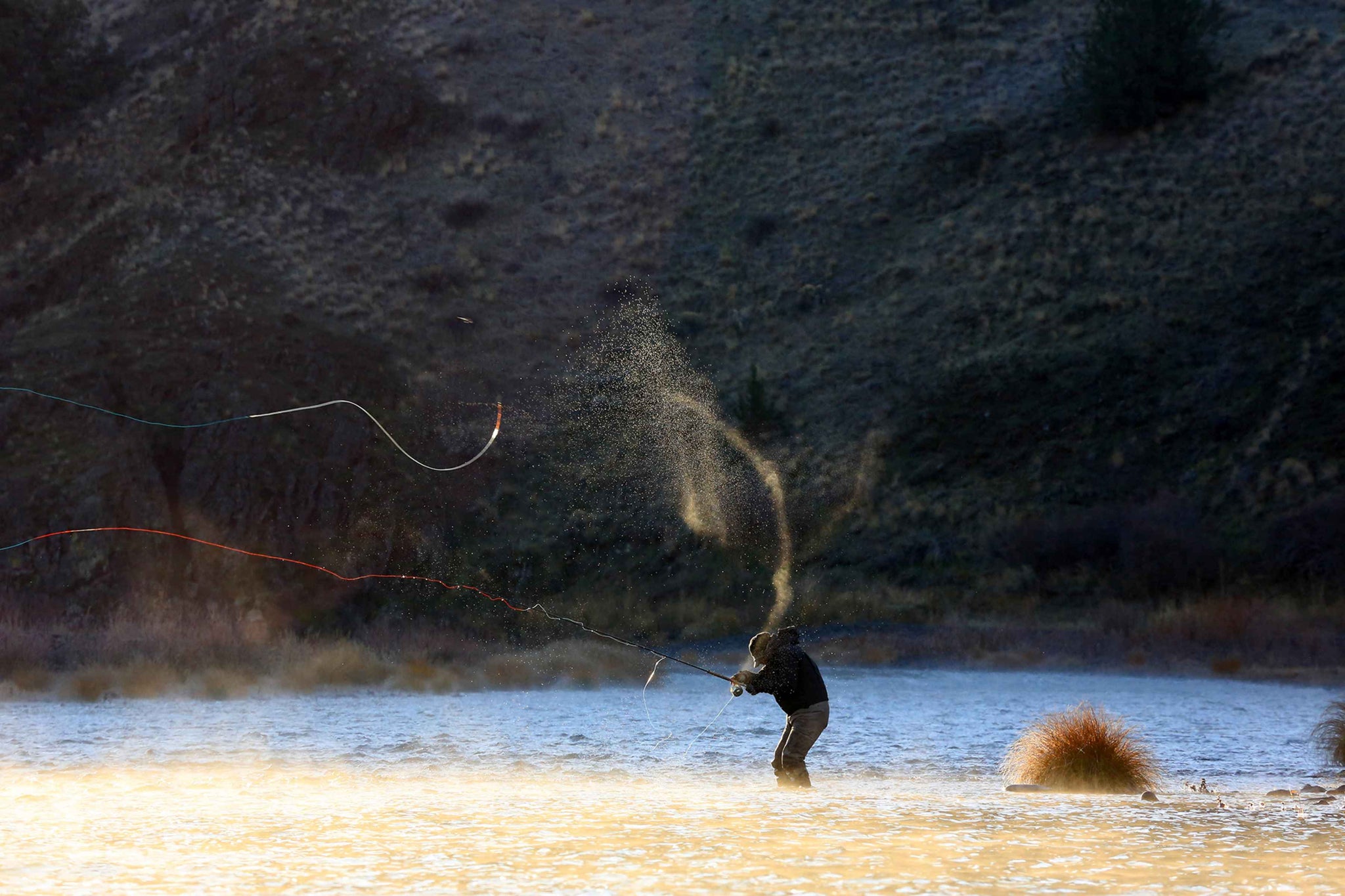
When I think about images synonymous with fly fishing for steelhead I picture a frostbitten sunrise on a sprawling river like the Skagit.  I imagine wading deep into the river’s flow feeling for purchase on the cobble rocks with numb feet.  I can hear the line rip free from its anchor point on the waters surface as I swing the thirteen foot double handed rod wide to form a D-loop, and then up and out over the river.  I make a big mend to let the sink tip do its work and then tighten on the line.  The fly swings across the current searching for a fish.  Nothing.  Cast, mend, swing, step, repeat…_MG_3525

A steelhead fisherman covers water while searching out his quarry.  Patience, persistence and meticulous attention to detail are his key virtues.  Countless hours spent on the water have given him a keen sense of his surroundings.  He is aware of the subtle changes in current speed caused by variations in the river bottom.  He has faced the disappointment of arriving to a raging torrent of a river after a fresh winter rain and the challenge of tempting a large silvery fish from the bottom of a crystal clear pool under the midday august sun.

This is the depth I was lacking, and in learning to fish with a two handed rod I was taking my first step to becoming a “real” steelhead fisherman.

This idea was driven home for me when Ted and I drove out to the Hoh river to fish it one final time before it closed for the season.  Like any fishing trip it began with high hopes and giddy, sleepless nights in anticipation of that electric surge when a fish is peeling drag off of your reel.

Within ten seconds of arriving at the river and wetting my line I knew I would not be experiencing that feeling on this particular trip!  My casts were awkward and disjointed.  On each successive attempt my line would appear to die right in front of me, leaving me feeling quite impotent as an angler.  To make matters worse, boat after boat drifted by us with gear fishermen raving about how many fish they were catching.  We even observed one set of anglers cleaning two beautiful chrome bright wild fish at the edge of the river, a saddening and frustrating sight on a number of different levels.

One might think that feeling the intense frustration of not being able to fish effectively while numerous others were enjoying success would cause me to throw down the spey rod and grab the glow bugs and strike indicator.  To be honest, there were a few moments when the only thing keeping me from launching the thirteen foot contraption clear across the river like a javelin, knowing full well I could throw it further than I could cast at that moment, was the fact that it had the name Dave McCoy engraved on the butt section just above the cork.  However, I never once thought about switching back to the training wheels.  My resolve was set, and my desire to learn to spey cast greatly exceeded my desire to land a steelhead.

Luckily I was not alone in my struggles, and I had some lessons from Dave, who is a phenomenal teacher, to fall back on.  So I started with the fundamentals I had learned while casting on green lake during my initial spey lesson, and along with a few helpful tips from Ted McDermott that fixed some hitches in my cast I eventually got to the point where casting turned into fishing.

Slowly the moves became ingrained and my casting turned into a rhythm.  Cast, mend, swing, step, repeat.  MyHoh_4-2010_sunrise numb feet dug into the cobble rocks and held fast as I stood thigh deep in the powerful current of the river.  I relished in feeling the “snap” in my snap-t and smiled at the satisfying sound of my anchor tearing from the water as I swung the rod wide to form a d-loop and sent the line sailing out over the river.  My frustrations were carried away in the flowing current and I was able to look upon the place I was in with new eyes.

Bald eagles soared overhead.  The afternoon sun warmed the back of my neck.  As the power and beauty of the Olympic Peninsula soaked in I reflected that Ted and I had it pretty good.

On day 2 Ted got himself a fish. And we were able to explore a beautiful section of the upper river.

Ted's beautiful buck

Ted's beautiful buck

We met up with some fellow guides, Dylan Rose and Ryan Smith who were drifting the upper river in Dylan’s raft.  Together we enjoyed a beer and some laughs.  Ryan was gracious enough to allow me to cast his CF Burkheimer double hander with a Skagit Line, a staggering difference from the old Sage VT2 and Delta line I had been heaving for the past two days.  I was reminded of yet another reason other than catching fish that I enjoy fly fishing.  Sharing my experiences with friends.

Hoh_4-2010_krusty

IMG_3498

To be clear, I do enjoy catching fish and I have nothing against nymph fishing.  In fact I still firmly believe that it is an effective tool for catching fish under certain circumstances.  If catching fish is the only goal you have during your trip, if that is your sole purpose for taking time off work and away from your loved ones and traveling all the way out to some gorgeous river in the middle of nowhere, then go ahead and nymph, you will catch fish.  However, If you are anything like me, then you might get to thinking that maybe in this crazy world of fish porn and internet forums, where competition is high and one-upping the last guy with more pictures of bigger fish has become the norm, maybe we should re-evaluate why we began fishing in the first place.  To get back to our roots.  To satisfy an urge to explore the unknown.  To get in touch with ourselves and our primal human instincts.  To master an ancient art form.  To become part of a worldly culture and recognize the importance of an energy greater than our own.  These are the reasons why I chose fly fishing as a path for my life.

No more training wheels for me!

(special thanks to Dylan and Ted for some of the great photos!)
Hoh_4-2010_fly

Written by: Charlie Robinton

Thank you spineless cowards…

Monday, March 29th, 2010

keyedburban1

Not much to say here other than I can’t believe the levels some will stoop to. If you keyed one of our company suburbans this week out on the O.P. and have something to say, by all means say it.

I more than recognize that we take some less than popular views on topics in our region and welcome and hope for open debate on these issues. In the end, we will respect you for your view and why you believe in it even if it differs from ours.

In this case however I will say this. Your parents should be and likely are ashamed and embarrassed to have raised you. If there was an immediate issue you wanted to take up, the phone number was right above where you went past with your keys. And to hit one of our other vehicles and cave in the entire back panel with your vehicle is a hit and run. Especially when you don’t leave a note.

Fortunately or unfortunately, however you want to look at it, kharma is always waiting for someone to pay forward to.

Written by: emeraldw

Stroft leaders and monofilament, oh yeah!

Tuesday, March 16th, 2010

logo_stroftonlanyard1
As someone who spends a lot of time fishing in extremely varied conditions and locations locally and internationally, I constantly look for new or better ways to accomplish my efforts. Leader and tippet material are no different.

In the world of trout, it is easy to stay complacent with what works and works well but when you are hitting cold saltwater, spey casting to steelhead with large flies and heavy tips and then breaking out the 000wt for small native trout in mountain creeks, not every spool of clear line performs the same across the board.

Lately I have been hearing about this material from Germany called Stroft so I called Rajeff Sports, the US distributor and asked if I could sample a few sizes for our saltwater and steelhead. “No worries, be there tomorrow!” they said.

So the word on the street is this stuff is very small in diameter for its breaking strength, maintains some pretty amazing turn over qualities with larger flies and in the wind. I will say from the past few weeks that all of this is way true.

Fishing Puget Sound in heavy wind with baitfish flies is not always easy and larger diameter tippet is at times great. However, using 16lb test of Frog Hair is out of the question as the fly acts as if tied to a dogs tail, fish are dumb but not that dumb. 16lb Stroft is nearly the same diameter as 12lb Deep Blue, more rigid but not to the extent that you risk the same fall backs as flourocarbon, has elasticity and knots seat down well.

For steelhead, no brainer here. Smaller diameter means is will sink more uniformly with tips and heavy flies and with the higher breaking strength on smaller material, spooky fish are obviously less likely to spot it. Hanging on the bottom and when trying to break the fly, you will think your line is going to give before it does, it’s that strong.

All in all, no brainer for me this stuff is awesome. Give it a shot and if your local shop doesn’t have it yet, have them contact Rajeff Sports or your local Airflo rep.

Tighter Lines!

Written by: Dave McCoy

All Puget Sound rivers to close early, as expected

Saturday, February 13th, 2010

WDFW NEWS RELEASE
Washington Department of Fish and Wildlife
600 Capitol Way North, Olympia, WA 98501-1091

http://wdfw.wa.gov/

February 12, 2010
Contact: Bob Leland, (360) 902-2817

Steelhead fishing will close Feb. 18 in five river systems around Puget Sound

OLYMPIA – Steelhead fishing will close Feb. 18 in five major river systems in the Puget Sound area to protect wild fish, the Washington Department of Fish and Wildlife (WDFW) announced today.

The closure will affect the Puyallup, Nooksack, Stillaguamish, Samish and Snohomish rivers and their tributaries.

Pre-season estimates developed by the department indicate that returns of wild steelhead will fall far short of target levels in all five river systems, said Bob Leland, WDFW steelhead manager.

“This is the fourth straight year that we’ve seen a downward trend in wild steelhead returns,” Leland said. “These closures are necessary to meet the conservation objectives of our statewide steelhead management plan and comply with provisions of the federal Endangered Species Act (ESA).”

Wild steelhead in the Puget Sound region have been listed as “threatened” under the ESA since 2007. Although anglers are required to release any wild fish they catch in those rivers, some of those fish inevitably die from the experience, Leland said.

Rivers closing to steelhead fishing Feb. 18 include:

Puyallup River system

•Puyallup River mainstem from the 11th St. Bridge in Tacoma upstream to Electron Power Plant Outlet
•Carbon River from the mouth to Hwy.162 Bridge
•White (Stuck) River from the mouth to R Street Bridge in Auburn
Nooksack River system

•Nooksack River from the mouth to the confluence of the North and South Forks
•North Fork Nooksack from the mouth to Nooksack Falls
•South Fork Nooksack from the mouth to Skookum Creek
•Middle Fork Nooksack from the mouth to headwaters.
Samish River system

•Samish River from the mouth to the Hickson Bridge.
Stillaguamish River system

•Stillaguamish River from sloughs south of Marine Drive to forks.
•North Fork of the Stillaguamish from the mouth to Swede Heaven Bridge.
•South Fork of the Stillaguamish from the mouth to the Mt Loop Hwy. Bridge (above Granite Falls).
•Canyon Creek from the mouth at the South Fork of the Stillaguamish to the forks.
Snohomish River system

•Snohomish River from mouth (Burlington-Northern railroad bridges) to the confluence of the Skykomish and Snoqualmie rivers including all channels, sloughs, and interconnected waterways.
•Snoqualmie River from the mouth to the boat launch at Plum Landing (~1/4 mile below Tokul Creek).
•Skykomish River from the mouth to the forks.
•North Fork of the Skykomish from the mouth to Deer Falls (about ¼ mile upstream of Goblin Creek).
•South Fork of the Skykomish from the mouth to the Sunset Falls Fishway.
•Pilchuck River from mouth to the Snohomish city diversion dam.
•Sultan River from mouth to the diversion dam at river mile 9.7.
•Tolt River from mouth to the confluence of the North and South Fork.
•Raging River from the mouth to the Highway 18 Bridge.
The Wallace River, Tokul Creek and Snoqualmie River above the boat ramp at Plum Landing will close Feb 28.

Written by: emeraldw

Washington Steelhead, IGFA and Joan Wulff

Monday, February 8th, 2010

Tell me that the most recent issue of Fly Rod and Reel hasn’t printed what I am sitting here reading, oh my GOD! After such a stellar issue last month, dedicated to steelhead, FR&R just took about 5 steps backwards and took Joan Wulff with them.

In this industry it is easier and unfortunately safer to steer clear of hot topics, leaving them open to debate amongst many who are seeking guidance on these issues from those they trust and respect. I would wager thousands of anglers are looking for someone to be an authority on the topic and yet has anyone besides a handful of conservation organizations in the region been willing to step up to that plate? No for fear it might, “offend and turn off prospective customers or existing ones…” author will remain anonymous and clearly a glass half empty type of personality.

Rather it should maybe be viewed as if you are passionate enough to stake your reputation on the well being of a species that doesn’t speak English or any other language to my knowledge, for the betterment of society and those who rely on them for their livelihood, maybe you will attract like minded clients/customers and turn existing ones into life-long believers with you.

Unless you live here in the Pacific NW, have had your life affected by these magnificent fish and what they endure to become a part of that said life, then you don’t have a right to say, endorse or have anything to with the future of these species. Nothing!

Why does Joan feel the need to associate herrself with this unfortunate story? For her to introduce such an article shows the uninformed and removed state of those who do not live and breathe the plight of these fish day in and day out as a part of working in this industry and more importantly in this region.

In fact it is quite cavalier for her act this way while at the same time have this in every FFF Flyfisher magazine:
magcover_joanwulfffff1

Can you be anymore hypocritical…this is not what these fish or this industry needs. We need well respected and world renowned anglers and conservationists to positively politicize acts like this for the benefit of the fish.

While on the subject, why does the IGFA have, allow or even accept applications for species in peril? World Record status of steelhead and other species around the world that are in serious trouble with regards to their long term sustainability should simply be put on hold or closed to change until they have regained at least a portion of their former populations.

As an organization that is supposed to represent our industry they too should have a higher standard and conscientious view of what it means to remove such a species from the gene pool.

The mention that this was the largest steelhead ever caught by IGFA records also shows a gross negligence in making sure they have compiled what is out there on record so as to give a more competent detail of their history.

Hey, IGFA, I did some of your work for you:

Idaho State Record
http://fishandgame.idaho.gov/fish/steelhead/

New York State Record
http://www.outdoorsniagara.com/new_york_state_record_steelhead.htm

British Columbia Records, scroll down to Area Records
http://www.noelgyger.ca/

bc_33poundsteelheadkispiox
RELEASED!

skeena_recordsteelhead1
RELEASED!!

I feel sorry for someone who needs to have their namesake based on the killing of such a magnificent fish. Especially when looking to the not so distant future could find that is was also the beginning of the end of their race. Hind sight being 20/20, that might have been a good question to ask yourself before giving it the granite helmet huh Pete.

I would hope that when I die, my kids and with luck grandkids will look at what I believed in and fought for and be proud, knowing I was attempting to allow them the same pursuits I enjoyed growing up.

NONE of us out here believe the “it was bleeding” story. I have not seen one picture supporting this claim to be true and by the undertones in Pete’s article, he knew exactly what he was doing, where is the closest certified scale IGFA will accept that I can find…absolutely deplorable.

And as for Joan Wulff, make up your mind. Do you “Hold the future in your hands, and then release them” or do you kill them and grab the worthless little bit of history and run? What sort of lesson does this teach our up and coming generation of anglers? I am sorry to say I lost much of the respect and admiration I had for you.

As for FR&R, by simply printing the story without a side bar of comment by the magazine, you have endorsed this. A publication of this stature should be first in line to “police” such a story by putting the right spin on it. Only hope is to have it create enough awareness to help alter the policy here in WA but I wouldn’t hold my breath.

WDFW shoulders a good portion of the blame for this as well. Several years ago they took a step in the right direction by making ALL wild steelhead in Washington mandatory catch and release. Pressure from a small town called Forks made the entire fisheries management board back off this decision, allowing 1 wild steelhead be kept and we have been in a back peddling tailspin since. Their disparaging numbers currently compared to historical figures should easily warrant such a decision.

I LOVE this industry. I have dedicated 20 years of my life to it and to helping others marvel at its wonders and will continue to do so. But at times I am floored by the selfish nepotism abound in certain circles of our industry and it is time to grow up.

I will end this on these words:

“We have reached the time in the life of the planet, and humanity’s demand upon it, when every fisherman will have to be a river-keeper, a steward of marine shallows, a watchman on the high seas. We are beyond having to put back what we have taken out. We must put back more than we take out.”
The Longest Silence – Thomas McGuane

Was this too harsh? Tough, it needed to be said and thank you Dylan for pulling on the reigns.

Written by: emeraldw

Not just 1 dead wild steelhead!!!

Thursday, January 28th, 2010

Here in the wonderful state of Washington, we are still allowed to kill one wild steelhead a year. I am not sure the notion of killing one female with her nearly ready to release eggs is taken into consideration as this angler just killed more than one. hoh_steelheadeggsonground1
Here lays the future of a species that are about to go away forever and yet policy around the region is allowing for the killing of not just one fish, but as you can see here, potentially hundreds.

Things have to change. Today my dad encouraged me to be reasonable and factual with regards to my reaction to such sights and future articles regarding steelhead because reason is irrefutable and people will listen to it.

I couldn’t agree more and yet I simply can’t control my feelings when I see the residuals of a wild steelhead killed and its hopeful offspring left to help the grass grow. Tell this to a politician who has been reasonable about any other controversial issue. Seems to me it is just that much easier to muffle the sound of reason when that reason isn’t blasted from the rooftops, even when irrefutable.

This just isn’t making sense and yet so many out there, outside of our region are left to think these fish are just as abundant as they once were. It couldn’t be that bad, look at everyone who is guiding for them and how many they catch. What isn’t visible to those outside of the PNW or whom just simply aren’t involved with fish conservation at all is the tooth and nail fight that is being waged over a species of fish that is in many parts of the PNW, an ESA (Endangered Species Act) listed species, yes, the very same list the bald eagle was on.

These fish won’t recover if this matter or listing status isn’t taken seriously. Dylan Tomine has said there is encouraging work being done in certain places and while I agree, it doesn’t help the over all awareness of the fish. If an angler perceives the population of steelhead to be great on the Deschutes, then why wouldn’t the rest of the regions fish be in just as good of shape? This is the daily battle we have when speaking with clients who want to go steelhead fishing.

Yes, each fishery is unique and will require a unique set of management policies to save/recover/help/whatever the steelhead in that watershed. But if the word doesn’t not get out about the over all state of the fish, especially in Washington, we will all be looking for a new place to swing our flies.

Written by: Dave McCoy